Ask where the next frontier is and you might hear: Mars, the asteroid belt, the deep ocean trenches. Places where almost nobody goes and almost nothing gets built. Yet a frontier needs four things that are easy to list and hard to assemble: resources worth the journey, tools that can work the ground, legal room to build in, and people actually turning up. All four have now assembled in one place, and it is none of the distant candidates. It is the shallow grey sea between Britain and the Netherlands.
Governments have already done the sums
Frontiers open when something valuable becomes reachable. In the North Sea that something is wind, and the ambitions attached to it are signed policy rather than think-tank talk. In April 2023, at Ostend, nine countries (Belgium, Denmark, France, Germany, Ireland, Luxembourg, the Netherlands, Norway and the United Kingdom) committed to 120 gigawatts of offshore wind in the North Seas by 2030 and at least 300 gigawatts by 2050. A year earlier the goal had been 150 gigawatts among four states; within twelve months the target had doubled and the signatory list with it.
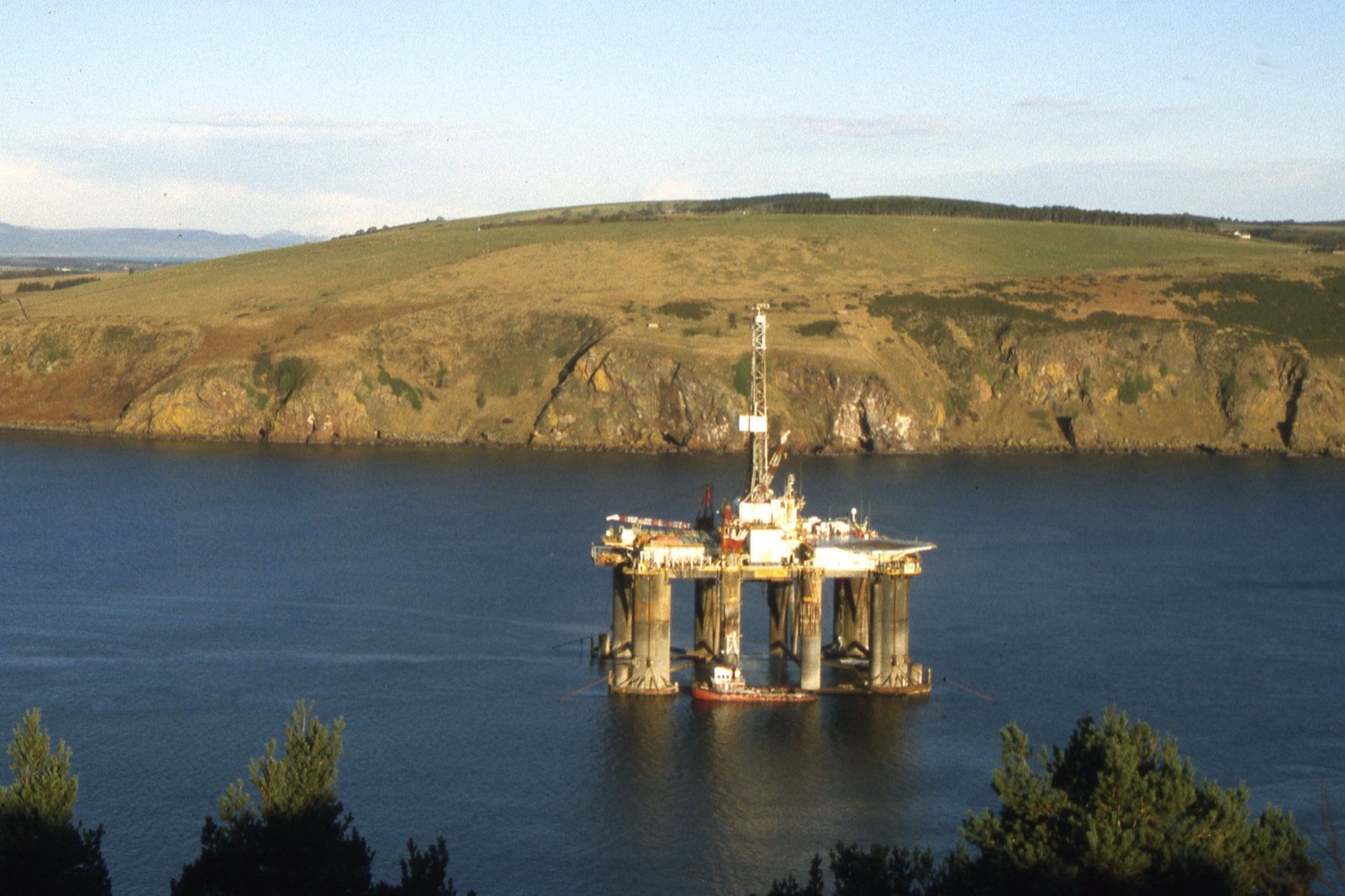
The build-out is well past the paper stage. Off Yorkshire, the Dogger Bank Wind Farm, a joint venture of Britain’s SSE and Norway’s Equinor, is completing what will be the world’s largest offshore wind farm, more than 130 kilometres from shore. Thirteen kilometres off Scheveningen, a converted gas platform called Q13a-A has produced the first green hydrogen ever made on a working installation at sea. Under the Norwegian seabed, the Northern Lights venture has begun permanently storing customers’ carbon dioxide, the first commercial service of its kind anywhere. Power, fuel and storage are all now delivered at sea, on commercial terms.
The tools were proven a century ago
The second requirement is engineering, and here the North Sea holds an advantage no other candidate can claim: the hardest part has been done before, on this coastline, at national scale.
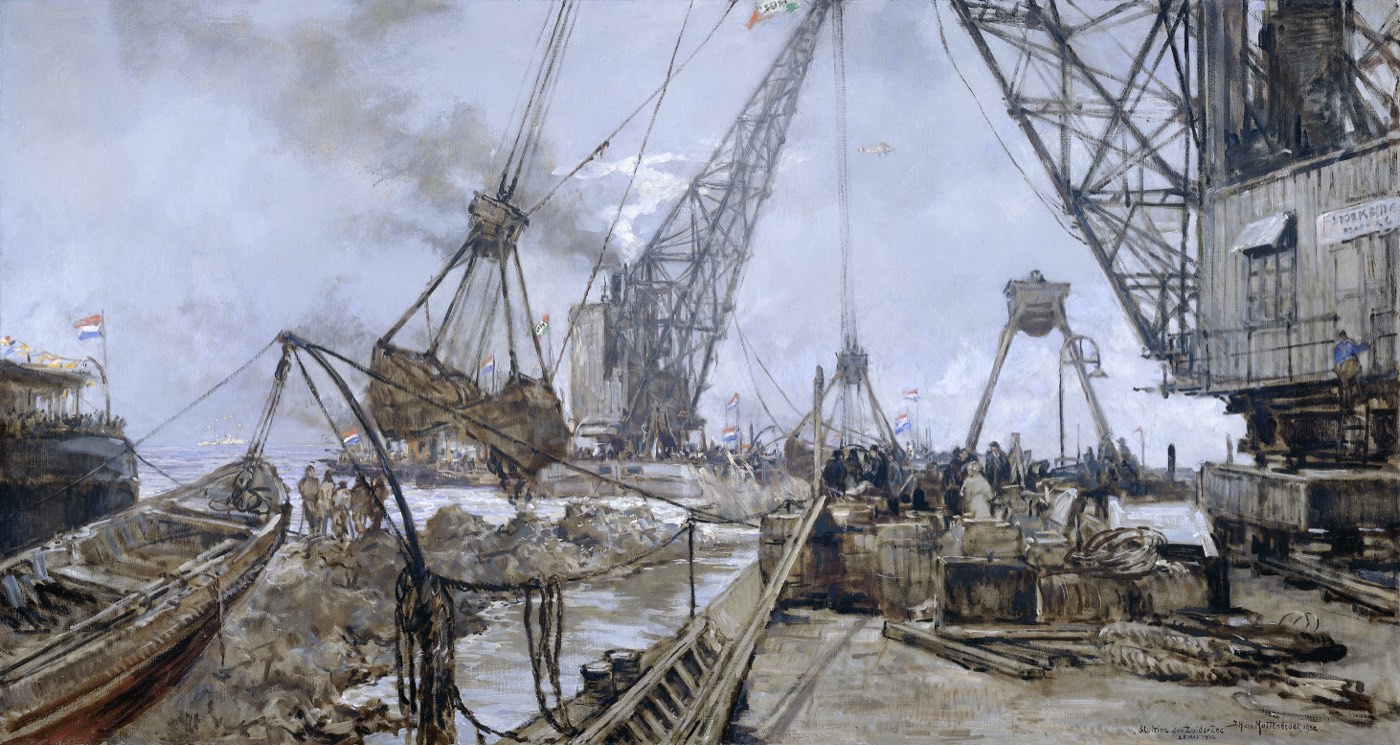
In 1916 a storm flood broke the dykes around the Zuiderzee, the shallow bay that then reached deep into the Netherlands. The Dutch parliament answered by voting to close the sea itself. Between 1927 and 1932 the Afsluitdijk, a 32-kilometre dam, was built across the bay’s mouth in open water; over the following four decades roughly 1,650 square kilometres of new polder land was pumped dry behind it. The largest piece, the Flevopolder, remains the largest artificial island on Earth: 970 square kilometres of farmland, towns and woodland where fishing fleets once worked, governed today as the province of Flevoland.
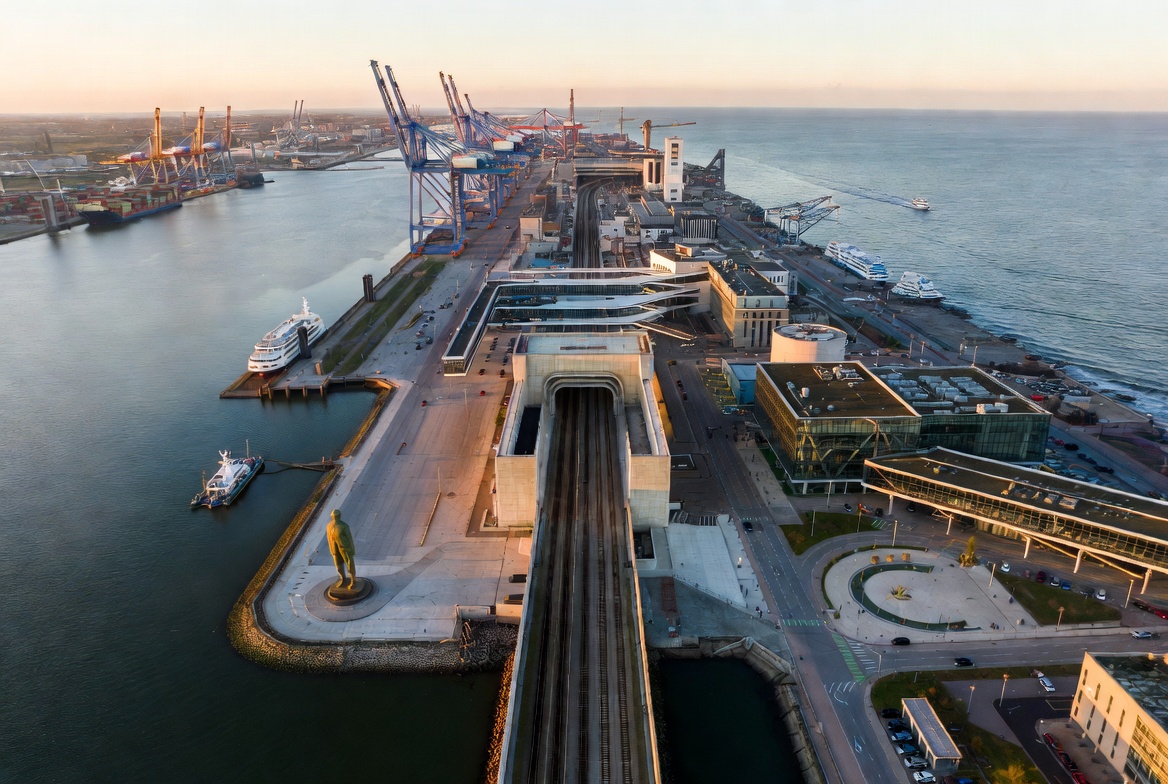
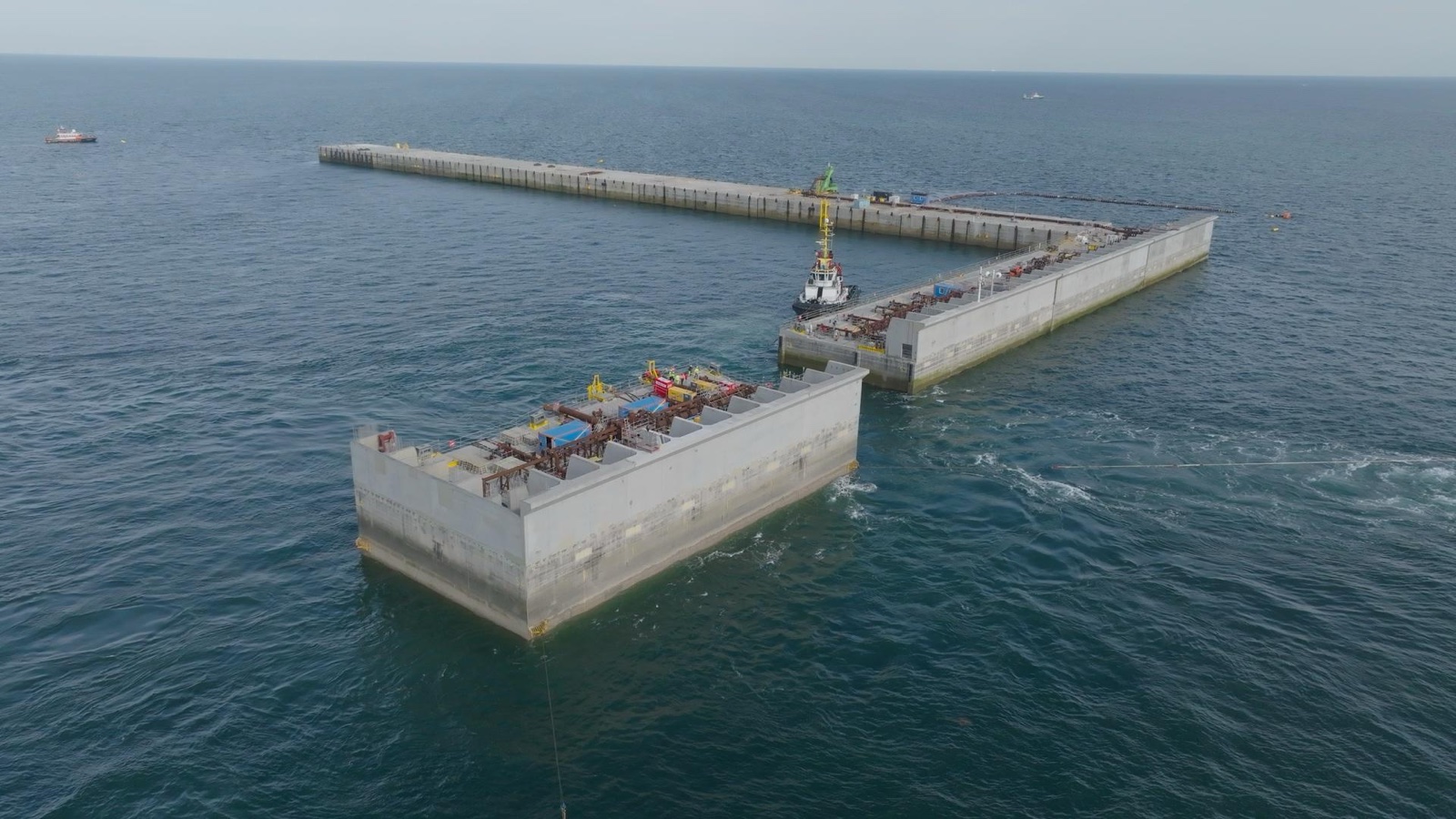
The current generation of tools is at work further out. Forty-five kilometres off Ostend, a joint venture of the Belgian marine contractors DEME and Jan De Nul is standing concrete caissons in a row to build Princess Elisabeth Island for Elia, Belgium’s grid operator: the world’s first artificial energy island, with seventeen of its twenty-three caissons already in place. Demand for the specialist fleet behind this work, the installation vessels, mega-dredgers and rock-placement ships, now runs so far ahead of supply that foundation contracts are signed years before a pile touches water.
Nobody owns the middle
Every land frontier in history was already somebody’s home, and that record is a dark one. The central North Sea is different: in the full territorial sense, it belongs to no one.
The Dogger Bank sits within the Exclusive Economic Zones of four states: the United Kingdom, the Netherlands, Germany and Denmark. Under the United Nations Convention on the Law of the Sea, an EEZ grants economic rights, not ownership. Artificial islands can be built there with the host state’s authorisation, and they generate no new territorial waters of their own. That leaves a defined, negotiable legal space in which something new could be governed into existence; the Svalbard Treaty of 1920, which pairs recognised sovereignty with defined rights for every signatory, shows what such an agreement looks like in practice. The four states already co-manage the bank’s protected areas through a joint conservation framework, so the institutional precedent exists.
The case against
There is a fair objection to all of this: that a busy industrial sea criss-crossed by shipping lanes is not a frontier so much as an offshore business park, and that its economics are currently punishing anyone romantic about it. The evidence is real. Belgium has dropped the direct-current component of Princess Elisabeth Island after converter prices rose far beyond its tender assumptions. The Dutch Zeevonk wind farm has pushed half its capacity from 2029 to 2032 because the hydrogen pipeline network ashore is running late. Costs overrun, schedules slip, and ambitions get trimmed in cabinet meetings.
The record suggests reading that as normal rather than fatal. The Zuiderzee Works were born of a flood, funded reluctantly, and rescoped more than once; the Netherlands still got its province. Meanwhile two kinds of arrival say more about the sea’s trajectory than any cost overrun. Navies now run standing patrols over its cables and pipelines, because what sits on this seabed has become worth defending. And rocket companies are preparing launches from a pad in Shetland and a floating platform off Denmark, because open sea downrange is becoming as useful to European spaceflight as it once was to European fishing.
People have lived there before
One more thing distinguishes the North Sea from every other candidate frontier: it has been inhabited. For thousands of years the ground beneath the central North Sea was Doggerland, a plain of rivers and reedbeds connecting Britain to the continent, until rising seas finished covering it around 8,000 years ago. Trawlers still bring up its harpoons and worked flints from the sediment. Any island built there stands on ground people once walked.
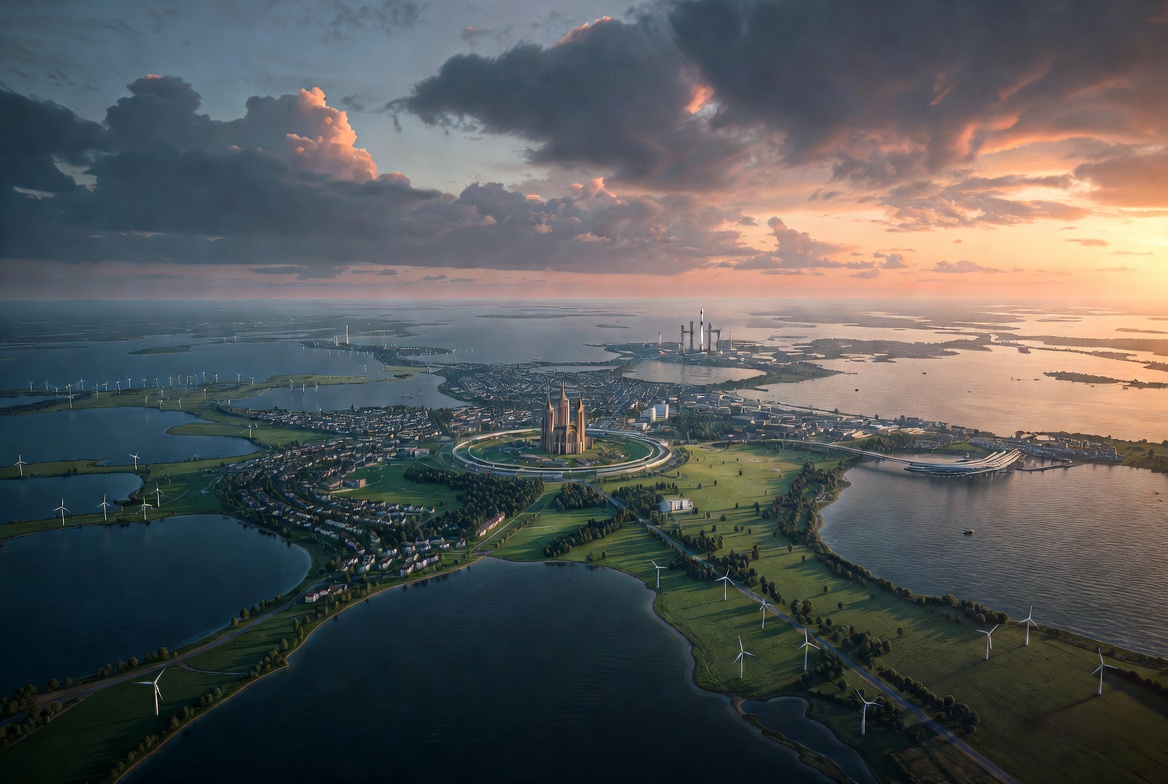
That is the setting in which Nieuw Doggerland, the project behind this site, makes its proposal: a working harbour, island towns, a marine sanctuary and an energy hub in the central North Sea between Britain and the Netherlands, built with the fleet that already sails, inside the legal room that already exists, serving the demand that nine governments have already signed. Each element is conventional; only the combination is new.
The demand is there, the tools are proven, the law leaves space, and the first artificial island is standing in the water. What the region does not yet have is anywhere to live. That is the gap this project intends to fill.
Source: offshore wind targets from the Ostend Declaration via WindEurope; Zuiderzee Works and Flevoland via Nationaal Park Nieuw Land and Britannica; Princess Elisabeth Island progress via offshoreWIND.biz; Zeevonk rephasing via offshoreWIND.biz.