The Vision · Ecology

A Sea
Brought Back to Life

Nieuw Doggerland is an act of restitution as much as construction. The same waters that once sustained the richest ecosystem in Northern Europe, the original Doggerland plain, can be restored, and protected by treaty so no future government can lobby it away.

Restitution, by Design

Centuries of overfishing and four decades of industrial bottom trawling have stripped the Dogger Bank and surrounding waters of much of their former abundance. One sixth of all UK commercial fish stocks are now critically depleted. The seabed (once a complex mosaic of oyster reefs, kelp forests, and maerl beds) has in many areas been reduced to bare sediment.

At full build-out, Nieuw Doggerland's protected zone would be one of the largest marine sanctuaries in the North Sea, contributing directly to the UK's 30×30 commitment and the EU's Biodiversity Strategy 2030 target of protecting 30% of European seas.

"Every island foundation is a reef. We do not treat that as a side-effect; we engineer it as a primary objective."
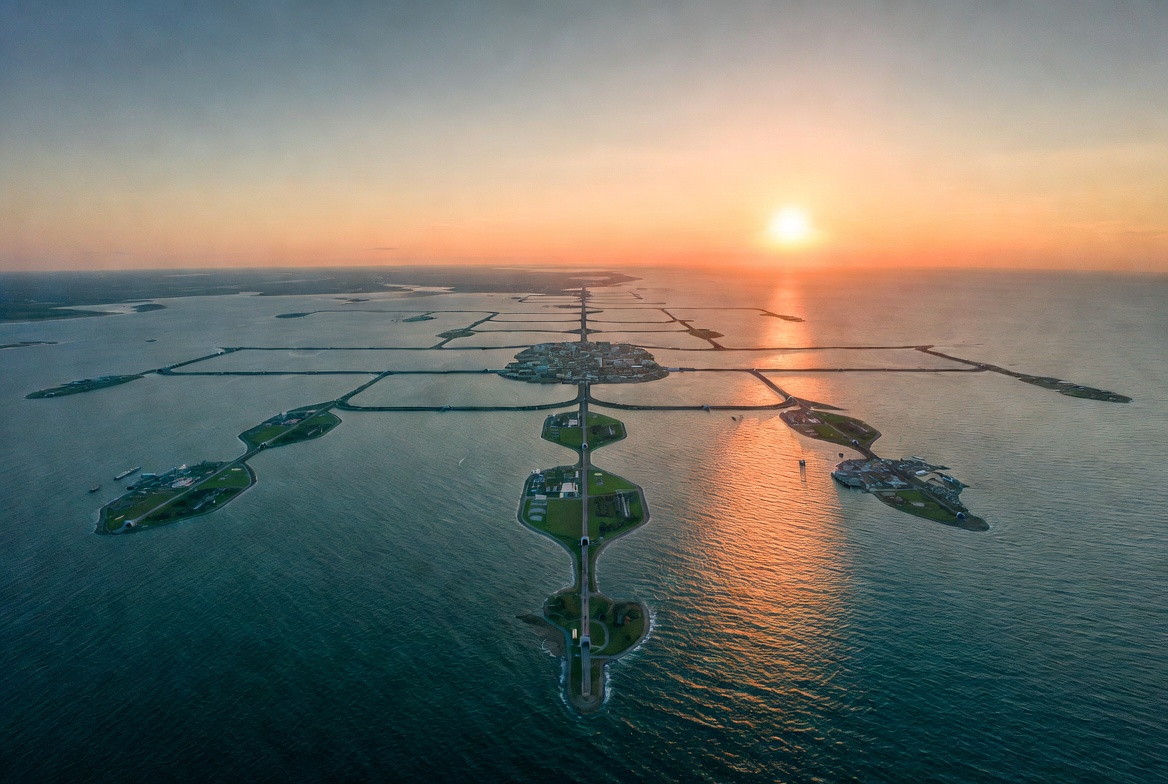
Polder archipelago with sheltered lagoons at sunset
50m+
Native oysters to be restored
30%
Aligned with UK & EU 30×30 targets
3–6×
Fish biomass recovery in no-take zones
5
Species in the hatchery restocking programme

Eight Commitments,
One Recovering Sea

The ecology mission spans three intertwined strands (habitat restoration, sustainable aquaculture, and hatchery restocking), delivered through eight concrete programmes and underpinned by open-access science.

01

Permanent No-Take Marine Sanctuary

The waters around each island and throughout the inter-island lagoons become permanent no-take zones, written into the founding treaty, not left to discretionary policy. Fully protected zones recover fish biomass three to six times within a decade, with spillover that benefits surrounding fisheries.

02

Native Oyster Reef Restoration

The European flat oyster (Ostrea edulis) once formed vast reefs across the southern North Sea before being fished to near-extinction. The sheltered lagoons are ideal for reef establishment; Nieuw Doggerland will host the largest oyster restoration in European history, a cumulative target of 50+ million oysters.

03

Fish Spawning & Nursery Habitat

The Dogger Bank was historically one of Europe’s great flatfish nurseries. The lagoons are designed to recreate those conditions: shallow, sheltered, seagrass-lined, and free of vessel disturbance. Seagrass planting, one of the ocean’s most efficient carbon sinks, begins in Phase 2.

04

Artificial Reef Engineering

Every island foundation is a reef. Rock armour, submerged concrete, and dedicated subsea geometries are designed with marine biologists from the outset to maximise colonisation by mussels, anemones, soft corals, and the fish that depend on them: an effect already visible around Dogger Bank wind foundations.

05

Hatchery-Based Restocking

Modelled on a century of sea-ranching in Japan, Korea’s 1.4 billion juveniles across 46 species, and New Zealand’s scallop revival, the research station runs a hatchery producing juvenile cod, plaice, sole, herring, and European lobster for release into the sanctuary, with monitoring to guide stocking rates.

06

Kelp Forest Restoration

Kelp forests have collapsed across much of the UK’s North Sea coast. The sheltered lee sides of the islands offer ideal conditions for native Laminaria, which supports over 1,000 species and sequesters carbon, paired with targeted urchin management to let young forests establish.

07

Rigs-to-Reefs Advocacy

Hundreds of decommissioned oil and gas structures host decades-old ecosystems that standard removal destroys. Nieuw Doggerland will advocate for a North Sea rigs-to-reefs framework, at no cost to the project, and giving it a credible voice in North Sea governance.

08

Marine Science Research Station

A permanent, internationally staffed centre partnered with NIOZ, Cefas, and Plymouth Marine Laboratory runs continuous monitoring, water-quality assessment, seabed mapping, and the hatchery. Its data is open-access; a public aquarium and dive programme make the mission visible.

Aquaculture here means sustainable shellfish and seaweed: no intensive finfish cages. Restoration and low-impact food production share the same protected water.

A Sanctuary for Birds and Mammals

Restore the fish and you restore the whole web of life that depends on them. The same protected water, sheltered lagoons, and undisturbed shorelines that bring back oyster reefs and flatfish nurseries also rebuild habitat for the seabirds and marine mammals of the North Sea, many of them in steep decline across the rest of these waters.

Predator-Free Seabird Colonies

North Sea seabirds (kittiwakes, guillemots, terns, and puffins) have been hit hard by collapsing sandeel stocks and avian influenza. Because the islands are built new, they can be kept free of the rats, mink, and foxes that devastate ground-nesting colonies elsewhere. Engineered ledges, shingle banks, and tern rafts offer secure nesting from day one, fed by the recovering fish below.

A Refuge on the East Atlantic Flyway

The southern North Sea sits beneath one of the world's great migration routes. Island wetlands, intertidal mudflats, and saltmarsh fringes create stopover and overwintering ground for the millions of waders and wildfowl (knot, dunlin, godwits, brent geese) that move along the flyway each year, adding resilience to populations under pressure from coastal squeeze.

Quiet Water for Porpoise and Cetaceans

The harbour porpoise, the reason much of the Dogger Bank is already a Special Area of Conservation, is joined by white-beaked dolphins and seasonal minke whales. No-take zones rebuild their prey base, while vessel-restricted lagoons and low-noise construction protocols give cetaceans the undisturbed, quiet water they need to feed and raise calves.

Haul-Outs for Grey and Harbour Seals

Grey and harbour seals need undisturbed land to rest, moult, and pup; the UK alone holds more than a third of the world's grey seals. The sheltered margins and sandbanks of the archipelago provide protected haul-out and breeding sites within reach of abundant, recovering fish stocks, anchoring a healthy resident population at the heart of the sanctuary.

A Mosaic, Not a Millpond

The islands and their breakwaters calm the sea so that oyster reefs, seagrass, and flatfish nurseries can take hold, but calming the whole bank would backfire. Fully sheltered, poorly-flushed water silts up, loses oxygen, and buries the clean, tidally-worked coarse sand that sandeels depend on. And sandeels are the keystone prey that feeds the very seabirds, seals, and whitefish this sanctuary exists to restore. A dead-calm lagoon is not a richer sea; it is a different, poorer one.

"The goal is not a calm sea. It is the mosaic of conditions the industrialised North Sea has lost, so nurseries, sandeel grounds, and reefs each have a place."

So the design is deliberately a gradient. Sheltered lagoons for nurseries, seagrass, and shellfish sit alongside tidally-active, wave-worked sandbank edges kept open for sandeels and the species that need moving water. Nothing is fully enclosed; gaps between the islands keep the tides flushing through, heading off the stagnation, warming, and dead zones that follow when a stretch of sea is simply walled off. Where it can, the wave-calming is done by living reefs (oysters and kelp that filter and oxygenate as they grow) rather than by static barriers behind which fine mud gathers.

Join the Founding Circle

Nieuw Doggerland is seeking marine biologists, fisheries scientists, oyster- and kelp-restoration specialists, and hatchery operators to design the world's most studied marine recovery zone. Join the Founding Circle.

Get Involved