Jan De Nul, the Belgian marine contractor, is finishing the last fronds and the crown of Palm Jebel Ali, the second and much larger of Dubai’s palm-shaped archipelagos, with the marine works due to complete in autumn 2026. Sixteen fronds sit inside a crescent breakwater. The firm is profiling 64 km of shoreline into beaches, which is roughly the length of the entire Belgian coast, and has taken on a further job widening the island’s central trunk by half a kilometre: another 10 million cubic metres of sand.
Add up everything placed since the first phase began in 2002 and Palm Jebel Ali will have consumed close to 200 million cubic metres of dredged sand.
Jan De Nul’s order book
Nieuw Doggerland, the project behind this site, proposes to raise new land on the drowned plain south of the Dogger Bank, between Britain and the Netherlands: a hub island and harbour first, then an archipelago. The standard objection is that nobody builds islands on that scale. Jan De Nul is one of a handful of firms that does, and it has three jobs of that order running at once.
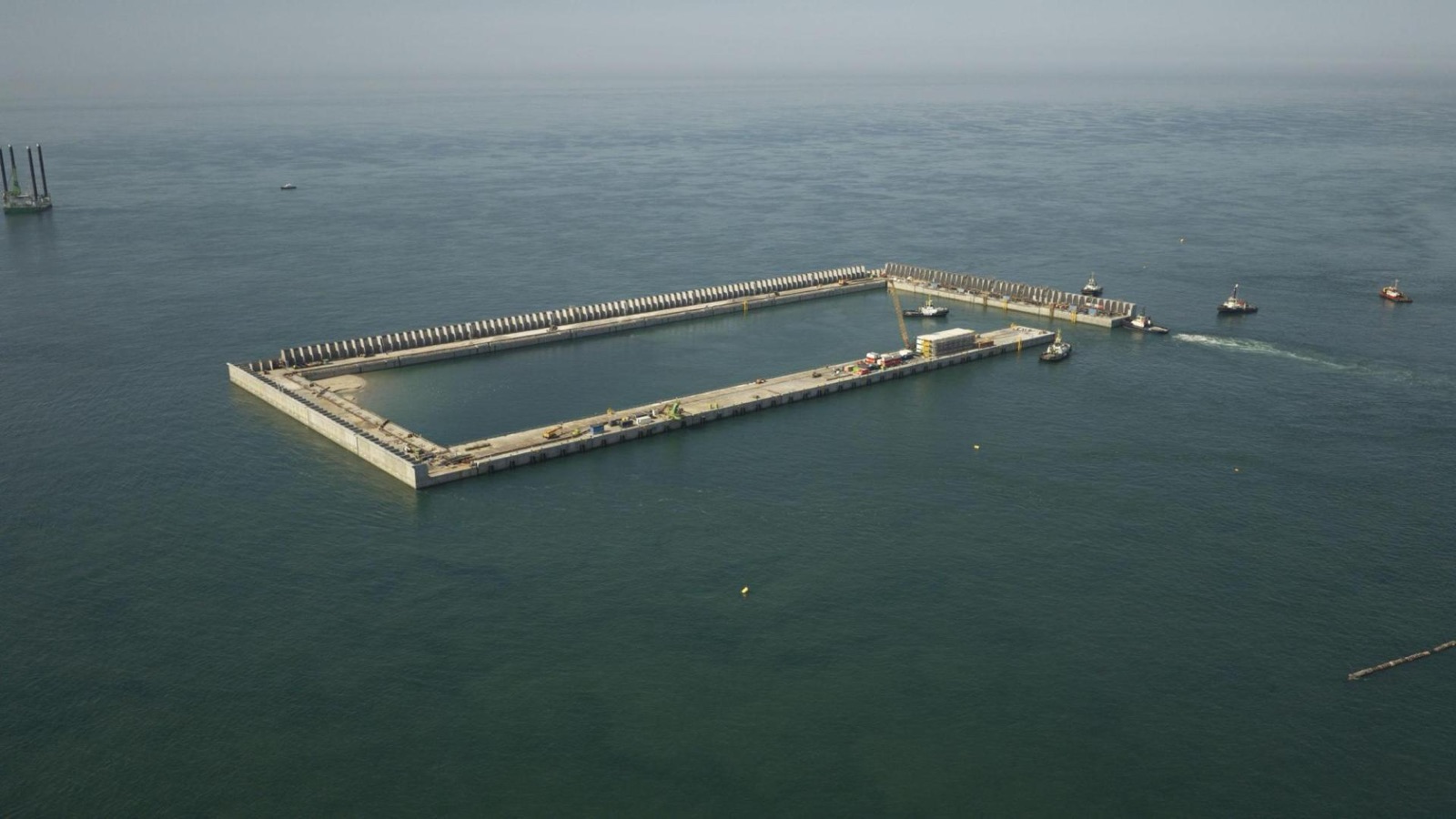
The same company, in joint venture with DEME, its Belgian competitor, is building Princess Elisabeth Island for Elia, the Belgian grid operator: a caisson-walled energy hub 45 km off Ostend, and the first artificial energy island anyone has attempted. It is also dredging the channels for Georgia’s first deep-water port on the Black Sea.
The method is unglamorous, and it is the method Nieuw Doggerland would use. A trailing suction hopper dredger, in this case the Filippo Brunelleschi, lifts sand from a licensed borrow area offshore, sails to the site and pumps its load ashore through a floating pipeline. Dump trucks and bulldozers spread it; vibro compactors and stone columns consolidate it into ground that will carry buildings. Around 400 people are on the job.
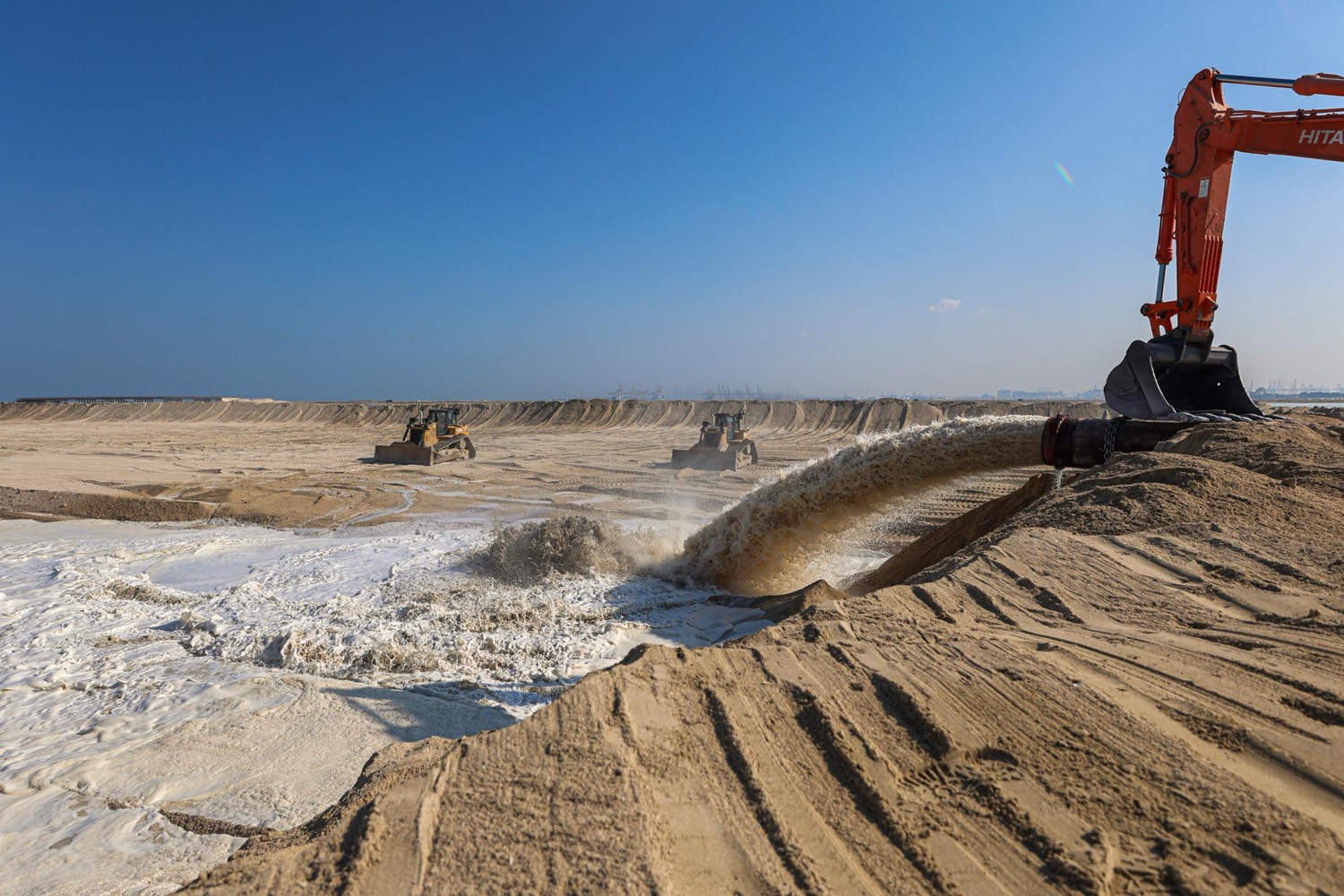
Twenty-six years from start to handover
Palm Jebel Ali was built in two stretches, with the 2008 crash and fifteen idle years between them. Construction began in October 2002, the breakwater closed in December 2006, and reclamation was substantially finished by 2007. Then the 2008 financial crisis arrived, Dubai’s property market collapsed, and the island sat as raw sand for fifteen years. By 2022 formal cancellation was under discussion.
Nakheel, the state-linked developer behind both palms, relaunched the project in May 2023 under a redrawn masterplan with larger plots and rebuilt infrastructure. Jan De Nul won the AED 810 million marine works contract in August 2024, covering dredging, reclamation, beach profiling and sand placement, with about two years to run. First property handovers are expected in early 2027 and full completion around 2028.
That is a twenty-six-year arc for an island whose land was finished in year five. The reclamation was complete a year before the crash. The years that followed were spent waiting for the property market to recover and for Nakheel to redraw the masterplan and fund the works. The risk in a made island is commercial: on Palm Jebel Ali, Nakheel carried it for fifteen years after the last load of sand went in.
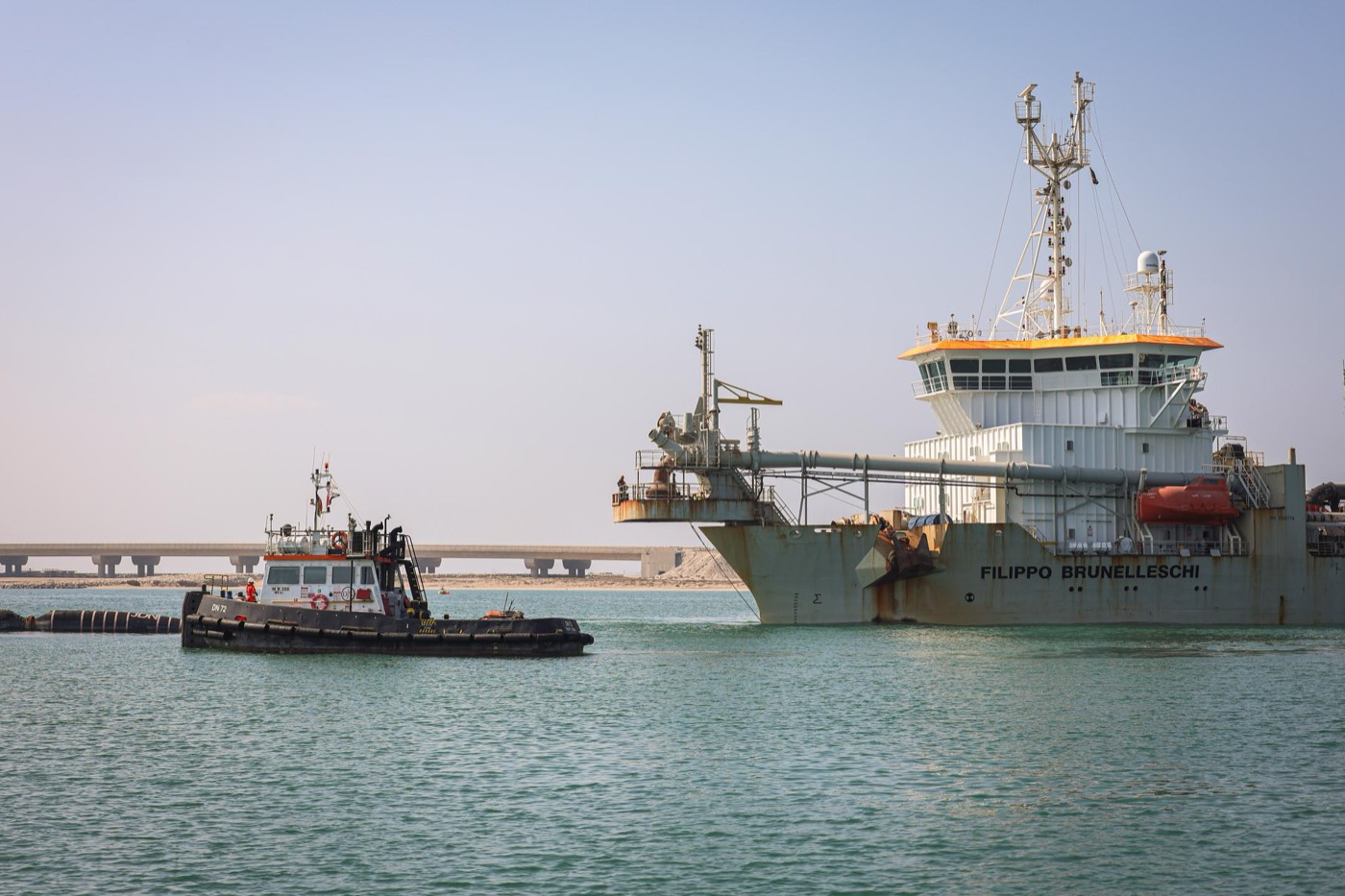
The part we would do differently
Palm Jebel Ali was built across the Jebel Ali Marine Sanctuary, protected in 1998 for holding one of the Gulf’s richest reef systems, with 34 coral species and 77 species of reef fish recorded. The protection did not survive the project; management of the reserve passed to the developer. Corals were relocated, reefs and seagrass beds were buried, and water circulation around the trunk turned out to be poor enough that fine sediment settled on surviving reef instead of flushing away.
Dubai made a choice about what that coast was for. Our position is that we do not have to make the same one in the North Sea, and the plan is built to demonstrate it. Every structure in the Nieuw Doggerland layout sits outside the designated sandbank and reef sites, on a plateau chosen partly because it is not itself a protected habitat, and that constraint is enforced mechanically: a geometry check runs before every build of this website and fails it if a planned island or lagoon overlaps a benthic conservation area. The ecology programme treats new reef and shellfish habitat as an output of the project rather than a mitigation owed against it.
On everything except the ecology, Palm Jebel Ali is our control case. The dredgers, the pipelines, the compaction plant and the crews that will one day be asked to raise Nieuw Haven are working in the Gulf now, finishing an archipelago of roughly the scale we propose, for a client who wanted beachfront. The marine works contract ends this autumn, and the fleet moves on to whoever booked it next.