On 18 August the trailing suction hopper dredger Tristão da Cunha was working the water off Anaklia, on Georgia’s Black Sea coast, and a second and much larger ship, the Al-Idrisi, was due alongside her before the month was out. Both belong to Jan De Nul, the Belgian marine contractor that is also, in joint venture with its compatriot DEME, building Princess Elisabeth Island for Elia: the Belgian grid operator’s energy hub 45 km offshore, and the first artificial energy island anyone has built. At Anaklia the two dredgers will cut the entrance and turning channels to roughly 17.5 metres, deep enough for Post-Panamax container ships, which are the vessels too wide for the old Panama Canal locks and too large for any port Georgia currently has.
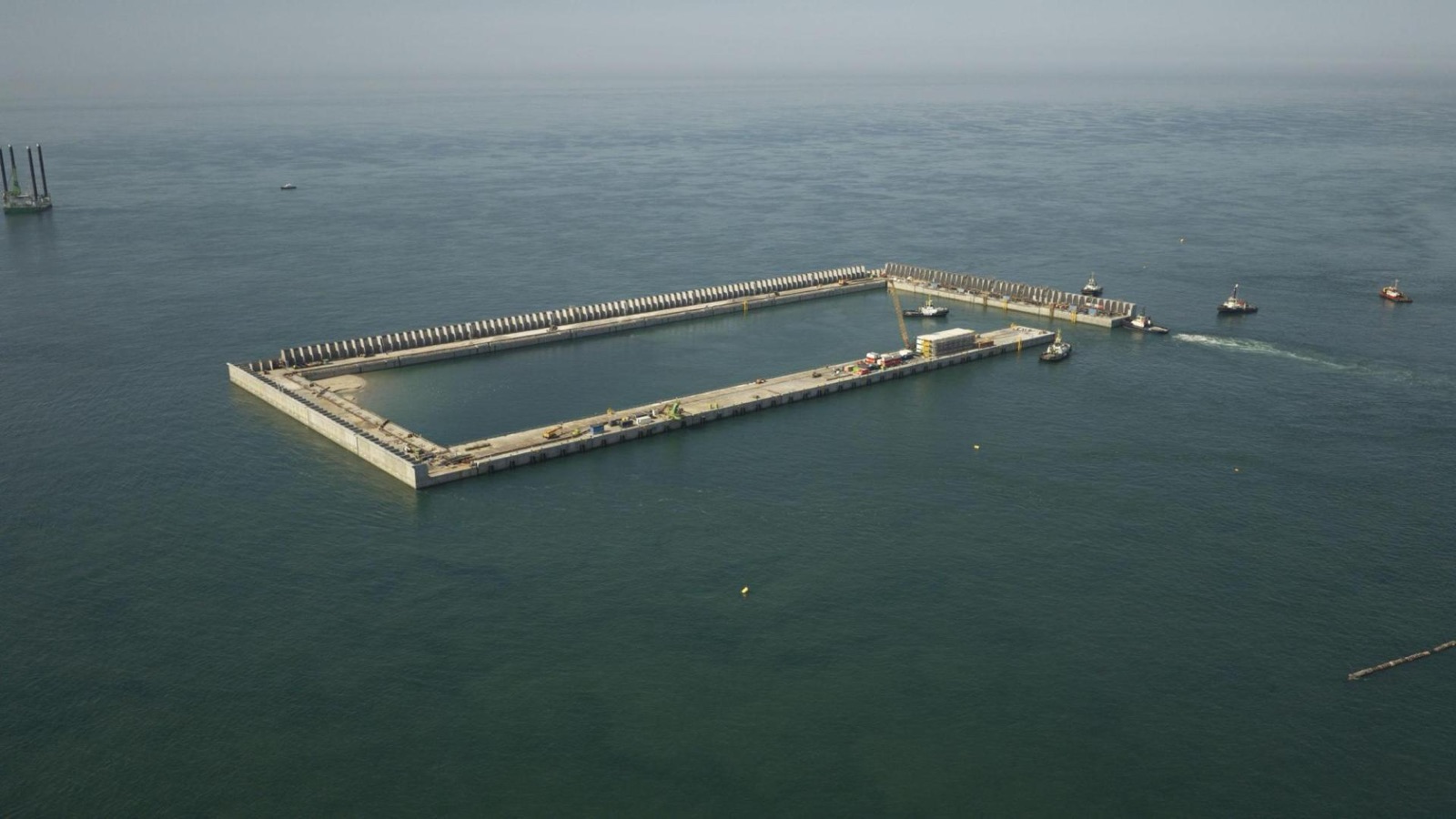
Then comes the breakwater: 1,376 metres of it, enclosing a basin that does not otherwise exist. Anaklia has a beach, a river mouth and no natural shelter whatsoever. Behind that wall the plan allows for up to 700 metres of deep-water container berths and up to 600 metres of jetty berths for dry and bulk cargo, giving a first phase rated at 600,000 TEU a year. A TEU is a twenty-foot container, the industry’s unit of counting; 600,000 of them is around 7.8 million tonnes of freight.
Nobody sails into an unsheltered coast
Nieuw Doggerland, the project behind this site, proposes to build new land in the southern North Sea between Britain and the Netherlands, on the drowned plain south of the Dogger Bank. Its first structure is a harbour: Nieuw Haven, whose rock-armour breakwaters enclose a pocket of calm water before a single load of fill is placed, because dredgers and barges cannot work a site that has nowhere to shelter when the weather turns.
Anaklia is the same problem from the other end. Georgia has a coastline but must dredge to 17.5 metres to berth a Post-Panamax ship. The plateau south of the Hornsea wind farms already lies at 20–30 metres, deeper than the channel Georgia is paying to cut, and has no land on it at all.
Both sites need the same two operations before a berth earns a fee: dredging, and rock. Anaklia cuts its channels first and closes a breakwater behind them; Nieuw Haven closes its breakwater first, because there is nothing out there to shelter behind.

A North Sea project would charter ships of exactly this class. The Tristão da Cunha is 89 metres long with a 3,500-cubic-metre hopper and can dredge to 27.6 metres. The Al-Idrisi, built at Busan in 2012, is 119 metres and 11,800 tonnes deadweight, with a 7,500-cubic-metre hopper.
Neither is exotic. The world fleet in this class is small and contracted years ahead, as the current run of offshore awards keeps demonstrating, so any Dogger Bank programme lives or dies by its place in that queue.
Ten years, three models, two collapsed consortia
Anaklia was announced in 2014. A Georgian-American consortium won it in 2016 and lost it in 2020, amid mutual accusations: the government said the consortium had failed to raise its financing, while the consortium’s founder said he was being squeezed, and was himself under investigation for fraud. He went on to found an opposition party.
In 2024 the government awarded a 49 percent stake to a Chinese-Singaporean consortium led by China Communications Construction Company, which drew immediate objections from Brussels and Washington on the grounds that Georgia was drifting from its Western partners. That deal was never signed either. By mid-2026 the Chinese partners were out and Georgia had adopted a third structure, the landlord model, under which the state owns the marine infrastructure permanently and private operators lease and run the terminals on top of it.
Three development models in ten years is not a construction schedule. Irakli Kupradze of the opposition Lelo party put it as “one government, three different models and only one outcome: Anaklia remains stalled,” and on the evidence he was right until this month. The Georgian civil-society group Civil Idea has raised the fair objection that a landlord port needs an independent port authority and competitive concessions to work as intended, and that neither is yet in place.

None of that delay was technical. Jan De Nul signed its marine-infrastructure contract in August 2024, worth about $204 million before a later renegotiation cut roughly $52 million out of it, and the firm has been ready since. What unlocked the site this month was a settled answer to the ownership question, arrived at four years after the last consortium collapsed.
Why a Georgian port is on our reading list
Nieuw Haven will have to answer the same question, and answer it before the rock goes in rather than after. Our proposition is that the first island’s harbour earns money from the day the breakwater closes, serving the wind farms already operating on the bank, which means somebody has to hold title to the basin and somebody else has to hold the leases on the berths. Georgia has just spent a decade discovering how much that structure matters and how little the dredging cares.
The landlord model it landed on is the one most European ports already use, Rotterdam and Antwerp included, and it maps cleanly onto a project convened by a foundation: a permanent, non-trading owner of the core marine infrastructure, with commercial operators on term leases above it. That is a governance question as much as an engineering one, which is why it sits alongside the case we make on sovereignty rather than in the construction plan.
The port expects its first ship in 2029, with the current dredging campaign due to finish in May 2027. On the roadmap we publish, Nieuw Haven’s construction phase runs 2029 to 2033. If Anaklia holds its dates, we will be able to watch a deep-water harbour built from nothing on an open coast, start to finish, in the years immediately before we ask anyone to fund one in the middle of the North Sea.