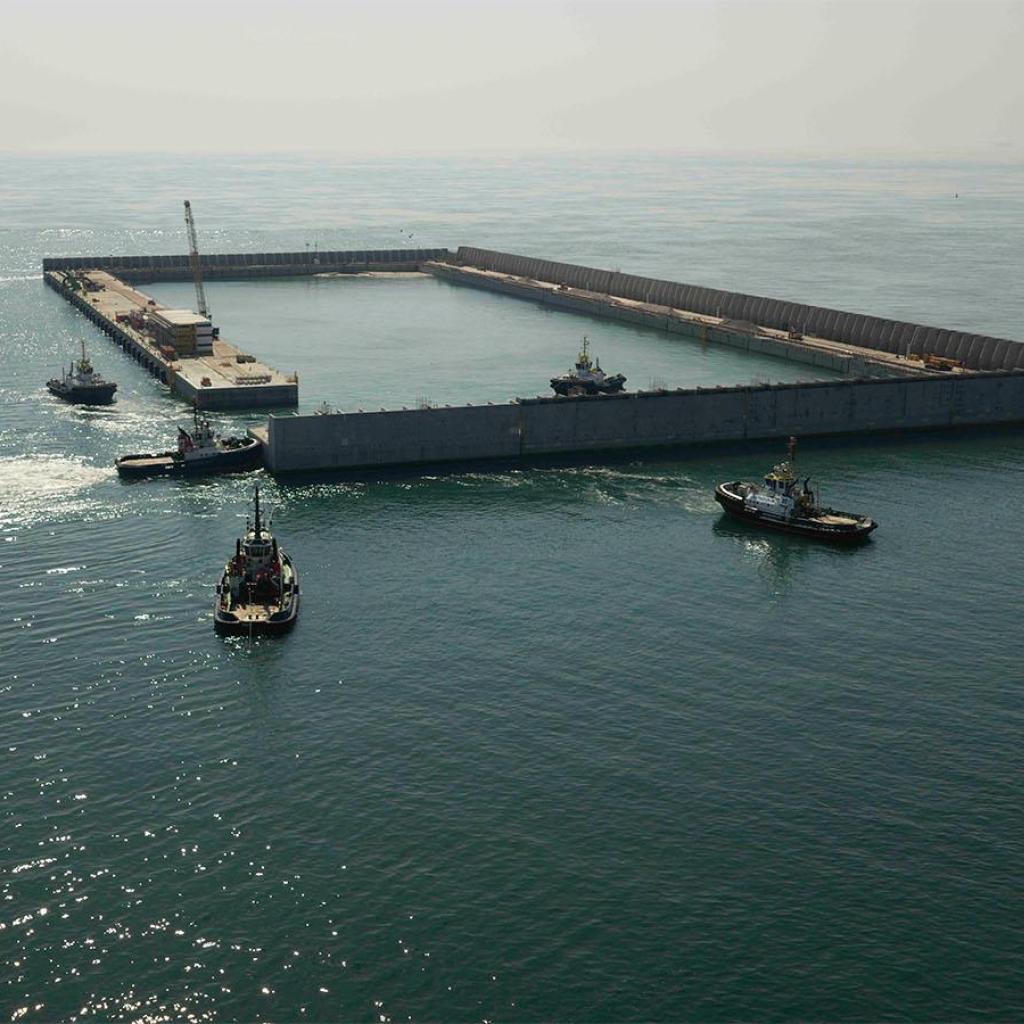
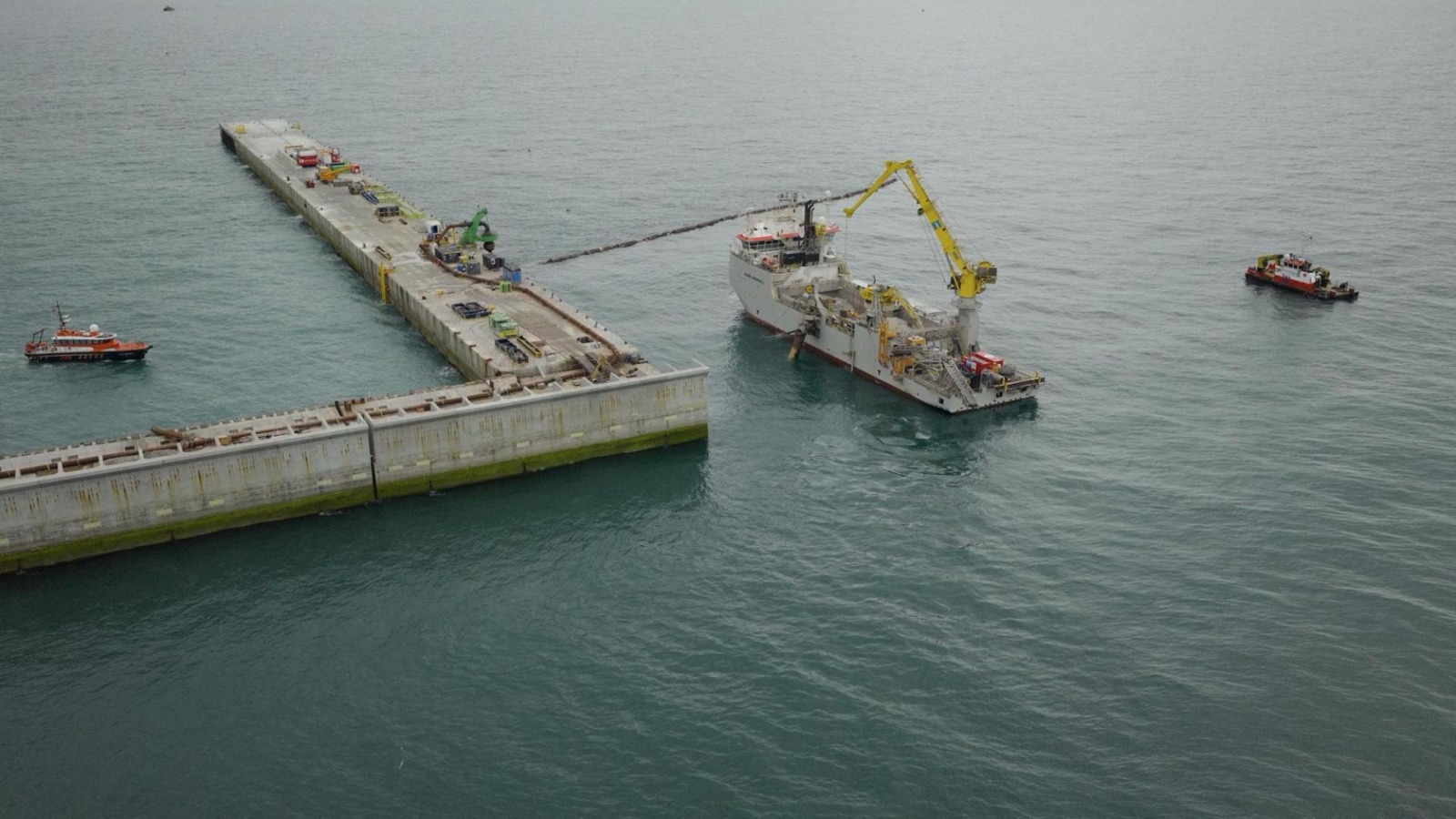
In August the 23rd and last concrete caisson was towed into place 45 km off the Belgian coast, closing the outer wall of Princess Elisabeth Island. The island is being built for Elia, Belgium’s electricity transmission operator, by TM Edison, a joint venture of the Belgian marine contractors DEME and Jan De Nul. It is the world’s first artificial island designed as an offshore grid hub, and with the wall complete the work moves from marine construction to filling and fitting out.
Three weeks later the European Investment Bank (EIB) announced a €1 billion green credit facility for that fit-out: the substation, switching stations and cables that connect the island to the Belgian grid. The loan was signed in July and is the bank’s largest for an energy infrastructure project in the Benelux.
Twenty-three caissons from Vlissingen
Each caisson is a reinforced concrete box 58 metres long and 28 metres wide, between 23 and 32 metres tall depending on whether it carries a storm wall. They were cast at Vlissingen in the Netherlands, about three months to each one with some 300 people working on the yard every day, then floated out and lowered onto a rock bed prepared on the seabed. Installation began in April 2025, paused for the winter, and resumed this spring; seventeen were standing in June, when we last reported on the island.
Finishing the foundations inside the agreed window keeps Elia eligible for €99 million of European Union support earmarked for this phase. Frédéric Dunon, chief executive of Elia Transmission Belgium, called the completion “a major step” in building Belgium’s offshore energy infrastructure.
Sand, then the substation
The next stage is to pump sand into the basin until it stands above the sea, a method dredging contractors call rainbowing after the arc of sand a dredger sprays from its bow. Cable connections to the mainland follow in 2027 and 2028, electrical installation from 2029, and Elia expects the island to bring its first power ashore in 2031. Finished, it will cover about six hectares, with a small harbour for crew transfers.
The EIB money pays for that electrical layer: a 220 kV substation on the island, 66 kV switching stations where the wind farm cables come in, transformers, and six three-phase 220 kV alternating-current cables to a substation on shore. It follows a €650 million facility the bank lent for the first phase in 2024. Elia puts the cost of the island and the connections to the first two wind farms at €3.6 billion.
The direct-current half of the plan
That figure covers less than the original design. The island was also to carry high-voltage direct-current (HVDC) converters, to connect a third wind farm of 1,400 MW and to land Nautilus, a proposed hybrid interconnector to Britain. In February 2025 Elia postponed signing the HVDC contracts, citing an overheated supply chain and prices well above its estimates; that summer the federal government told it not to sign and to work with the regulator, CREG, on a cheaper design.
By then estimates for the whole project had risen from about €2.2 billion to €7–8 billion before Nautilus was counted, the Brussels Times reports. Dunon has said a lighter revised design could take €2 billion off the cost of the direct-current equipment, and that design awaits a decision from the energy minister, Mathieu Bihet. How the cost of Nautilus would be split between Belgium and Britain is still unsettled.
Oysters on the scour rock
At the end of July, Jan De Nul placed rock around the foot of the caissons carrying young European flat oysters, grown with partners under a programme called Reefcovery. The rock is scour protection: it stops the current eroding the seabed at the base of the wall. The oysters are meant to grow into a reef on it, restoring a habitat that covered large areas of the southern North Sea until the early twentieth century.
Elia’s design also includes nesting ledges for seabirds and textured panels on the caisson faces below the waterline. Monitoring will show over the next few years whether the oysters survive and spawn on the rock.
What this means for Nieuw Haven
Nieuw Doggerland, the project behind this site, proposes to raise new land on the drowned plain south of the Dogger Bank, between Britain and the Netherlands, starting with a hub island and harbour called Nieuw Haven. Our construction programme uses the method Belgium has now completed at sea: caissons and rock armour, sand placed by dredger, and no piling. At Princess Elisabeth Island that part of the work finished on schedule and inside its subsidy window.
The cost growth came in the electrical equipment, and above all in HVDC converters, which every North Sea grid operator is ordering from the same few suppliers. Our energy programme also plans HVDC links from the hub to the British and Dutch grids. The plan opens Nieuw Haven first as a working harbour, with maintenance berths for the surrounding wind farms, port dues and a harbour of refuge, which gives the hub island an income that does not depend on converter prices.
Sources: foundation completion and Reefcovery via Jan De Nul and Baltic Wind; financing via the European Investment Bank and Offshore Engineer; costs and the HVDC decision via Elia and the Brussels Times.