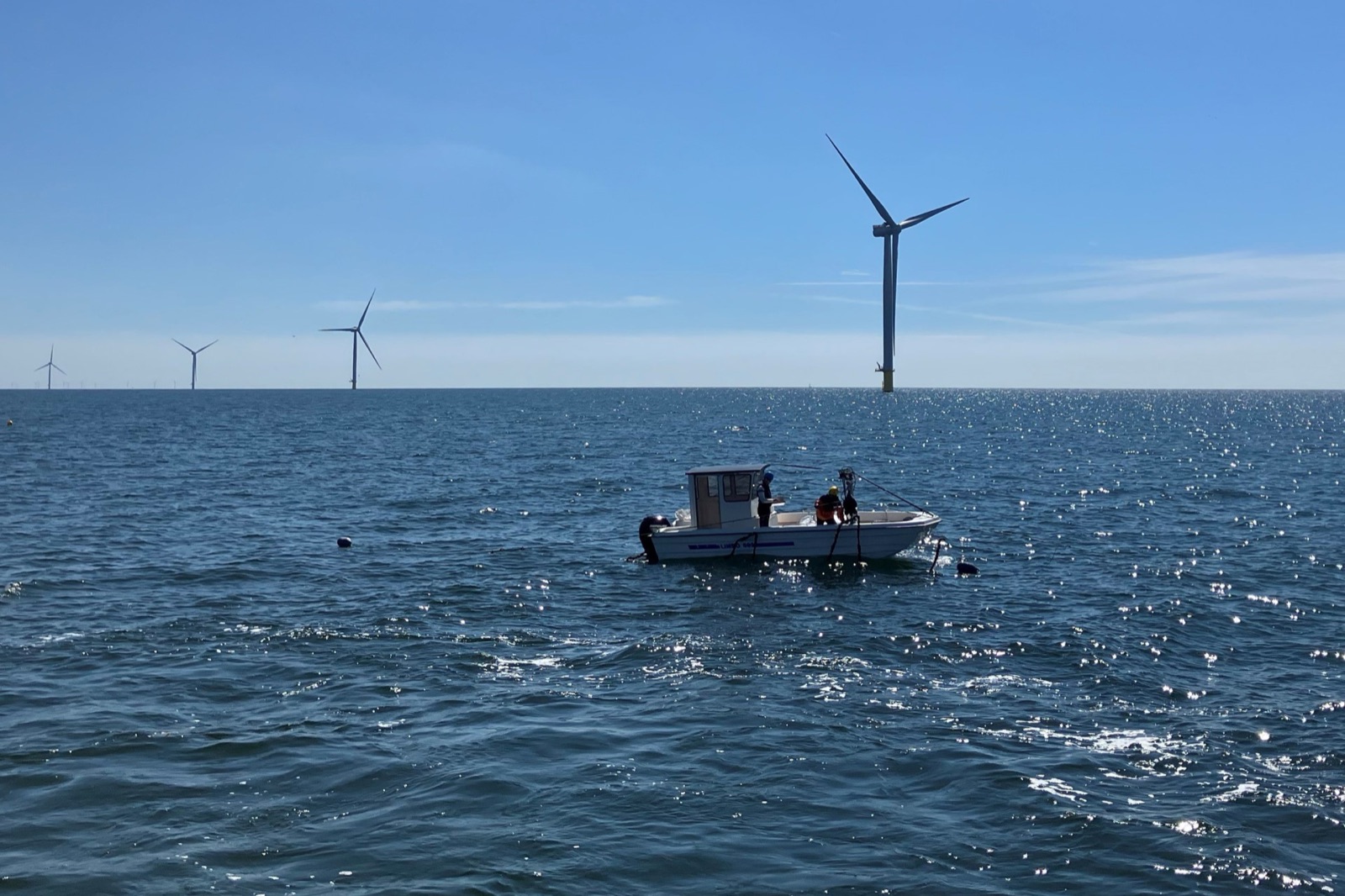
In May, a boat working the waters of the Vesterhav Syd wind farm off Denmark’s west coast brought in a crop that had nothing to do with electricity: lines of sugar kelp, grown between the turbines and landed for food production. The harvest is the headline result of WIN@sea, a Danish collaboration spanning Aarhus University, Vattenfall, Kerteminde Seafarm, DTU Aqua, the Kattegat Centre, and the University of Copenhagen.
The findings, published by Aarhus University in June, close a fifteen-year arc of Danish cultivation research. Seaweed can be grown at commercial scale in an operating wind farm; it thrives in offshore conditions; and it cleans the water as it grows, taking up more nitrogen and phosphorus than the researchers expected.
Two industries, one patch of sea
The significance is not the kelp; it is the address. Offshore wind farms enclose large areas of sea that other users are mostly excluded from, and the turbines’ foundations, cables, and service infrastructure were long assumed to make those areas single-purpose. WIN@sea demonstrates the opposite: the same hectares can generate power at the surface of the water column and food within it, sharing vessels, moorings, and logistics.
The harvested biomass has a market on several fronts. Sugar kelp is a food in its own right; it is processed into gelling agents and stabilisers; and it feeds into animal feed and bio-based materials. What is missing, in the researchers’ assessment, is not technology but demand: the supply chains linking growers to food manufacturers, retailers, and public kitchens still have to be built.
The working assumption behind Nieuw Doggerland
Multi-use is this project’s premise. Nieuw Doggerland’s plan puts an energy super-hub and a marine sanctuary on the same bank because we hold that a well-designed piece of sea can do several jobs at once. WIN@sea is that premise passing a live test in the North Sea, inside a working wind farm, with a real crop landed.
For our ecology programme the Danish result is doubly useful. Kelp is one of the habitats we intend to restore at scale across the archipelago’s sheltered waters, and cultivation and restoration draw on the same science: the same species, the same seeding techniques, the same understanding of what makes kelp thrive offshore. Every year of Danish cultivation experience shortens our learning curve.
Kelp also strips nitrogen and phosphorus out of the water column, which makes a crop of it a way of cleaning water as well as a way of growing food. Ring an island’s lagoons with kelp lines and the sanctuary gets a living filter around it. The Danes have shown the model works between turbines. We intend to give it an archipelago.