Every island begins with a stone, placed precisely, on the seabed. On 3 July, in the port of Rotterdam, the Dutch marine contractor Boskalis christened a ship built to do exactly that at a scale never seen before: the Windpiper, the world’s largest subsea rock installation vessel.
For a project like ours, whose first physical acts will be sheltering harbours and armouring the edges of new islands against the North Sea, this is the most interesting ship afloat.
What the Windpiper is
Converted over eighteen months from an ore carrier, the Windpiper measures 227 by 40 metres and carries 45,500 tonnes of rock in two holds. Through a moonpool and an inclined fallpipe, it places that rock on the seabed with precision: the technique used to protect cable crossings, scour-proof wind turbine foundations, and build the underwater slopes on which breakwaters stand. Seven thrusters and DP2 dynamic positioning hold it exactly on station while it works.
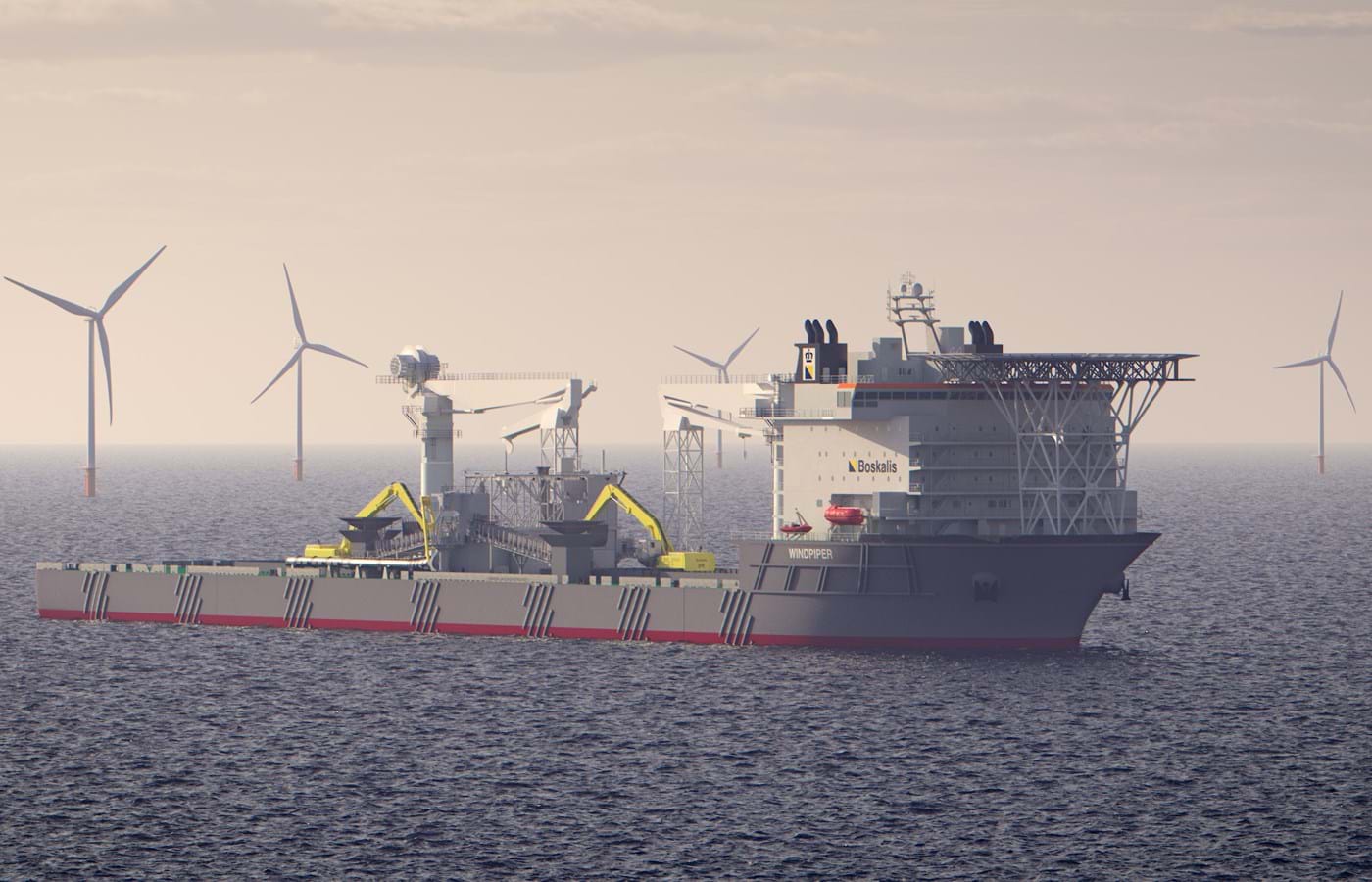
Boskalis says the vessel’s huge capacity is aimed at projects with long transits between rock loading facilities and the work site; among the named regions is the southern North Sea. That is our neighbourhood.
Why it matters to Nieuw Doggerland
To be clear about the relationship: the Windpiper is Boskalis’s ship, built for the offshore energy market, and Boskalis has no involvement in Nieuw Doggerland today. But our founding prospectus names the Dutch dredging and marine engineering industry, Boskalis explicitly among them, as the natural feasibility partners for the construction programme. This is the industrial base the project is designed to draw on.
And the arithmetic is suggestive. The first hub island pencilled into Phase 2 of the roadmap needs its perimeter armoured and its first safe harbour sheltered before anything else can happen on it: thousands of metres of breakwater foundation and scour protection, all of it laid stone by stone from ships like this one. A vessel that delivers 45,500 tonnes of rock per voyage, stationed in the southern North Sea, is precisely the kind of capacity the Islands programme will be chartering.
Eight thousand years ago the sea dismantled Doggerland grain by grain. Rebuilding it starts the same way in reverse… and the fleet for the job is being launched now. Fair winds and following seas to her crew.
Source: Boskalis’s announcement on LinkedIn, with vessel details via gCaptain and Offshore Engineer.