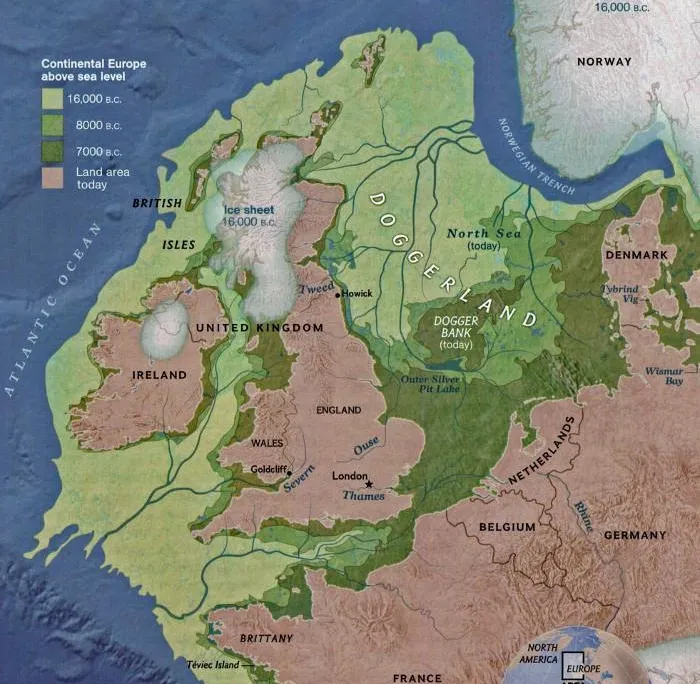
Ask who owns the Dogger Bank and you get a surprising answer: nobody. The bank lies well beyond the 12-nautical-mile territorial waters of any state. What exists instead is a patchwork of Exclusive Economic Zone rights: the UK holding the largest share in the west, the Netherlands in the east, Germany to the southeast, and Denmark along the northern boundary.
An EEZ grants a state authority over economic activity (fishing, energy, infrastructure) out to 200 nautical miles. It does not grant territory. That distinction, established under the UN Convention on the Law of the Sea, is the single most important fact in the Nieuw Doggerland legal case.
No sovereign to displace
Most territorial projects fail on a simple problem: someone already owns the land. Here, no one does. There is no sovereign to displace and no territory to cede; only a set of overlapping economic rights held by four states, each of which has strong reasons to participate in what we are proposing.
Under UNCLOS Article 60, a state may authorise artificial islands within its EEZ, and those islands generate no new territorial claims of their own. Any governance structure for Nieuw Doggerland must therefore be built by treaty: a feature, not a bug, because it forces the project to be multinational from its first legal act.
The four at the table. The UK and the Netherlands anchor the two ends of the land bridge and hold the largest EEZ shares; they are the natural primary co-founders. Germany and Denmark hold junior but legally necessary shares; no comprehensive treaty can be signed without them, and each brings something the project needs. Germany offers its established maritime governance machinery; Denmark its North Sea energy expertise.
The machinery already exists
This might sound like diplomatic fantasy, except that joint governance of this exact patch of seabed is already operating. The UK, the Netherlands, and Germany designated overlapping Special Areas of Conservation across 18,765 km² of the Dogger Bank between 2007 and 2012, and have co-managed them since. Nearly two decades of tripartite marine governance, on the very sandbank in question.
The treaty model we point to is Svalbard, 1920: one recognised sovereign framework, defined rights for every signatory. Applied here (the UK and the Netherlands as primary co-sovereigns, Germany and Denmark as signatories with guaranteed rights) it turns a legal vacuum into a constitutional foundation, with the 2023 Ostend Declaration on North Sea cooperation as the diplomatic springboard.
The full legal case, state by state, is on the Sovereignty page. The short version fits in a sentence: the Dogger Bank has no owner, four willing states, and a working precedent for governing it together.