Before this year is out, a Polish rocket is scheduled to lift off from a converted wind-farm service vessel anchored 50 to 100 kilometres west of Esbjerg. The North Sea has been a hunting ground, a battlefield, a gas field and a wind farm; it is now learning to be a launch range.
A spaceport made from the wind industry’s cast-offs
The platform is Spaceport North Sea, developed by the Danish-based venture EuroSpaceport. It is not a purpose-built marvel; it is a repurposed offshore wind turbine service vessel that sails out from Esbjerg, extends its legs to the seabed, and becomes a launch pad. Rocket integration happens in an ordinary retrofitted harbour building; fast boats clear the range and recover the payload.
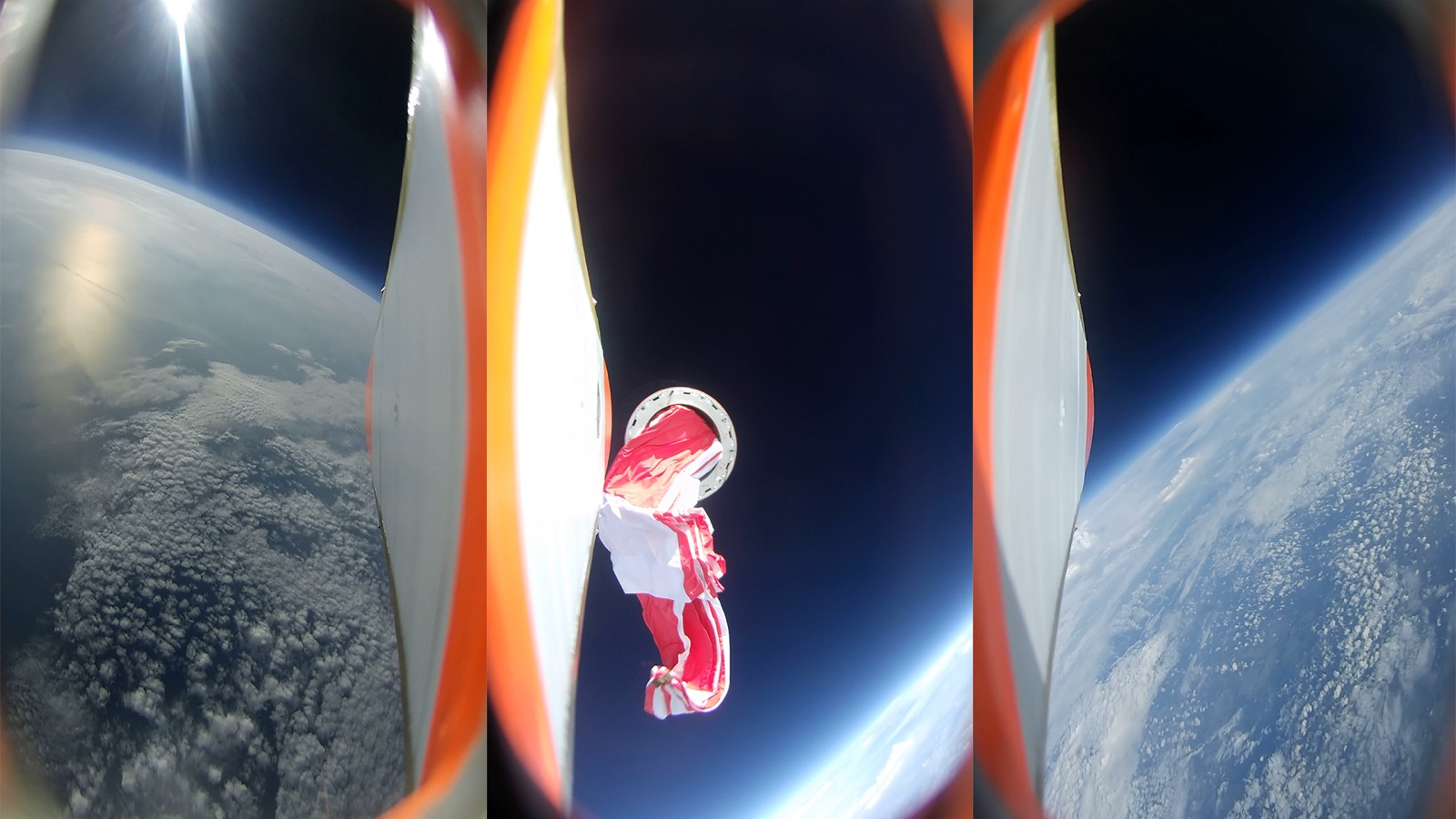
In July 2025, EuroSpaceport signed an agreement with the European Space Agency and the Polish rocket builder SpaceForest to fly the platform’s first mission, supported through ESA’s Boost! programme. The customer’s vehicle is Perun: an 11.5-metre suborbital rocket with a hybrid engine, designed to carry up to 50 kilograms of scientific experiments past the edge of space.
SpaceForest has spent the intervening year earning that window. Its SF-1000 engine passed final qualification in August 2025, complete with a thrust vector control system built for exactly this job: real-time trajectory corrections for launches from unconventional locations, sea platforms included. In November 2025 Perun flew a successful third test from Poland’s Ustka range, its first flight since 2023; a further qualification flight from Santa Maria in the Azores was pencilled in for the first half of this year, with the North Sea mission to follow.
Why it matters to Nieuw Doggerland
To be clear about the relationship: Spaceport North Sea is EuroSpaceport’s venture, SpaceForest builds its own rockets, and neither has any involvement in Nieuw Doggerland. What they are building is something we can only watch with interest: proof that these waters can host launch operations at all.
Our spaceport is pencilled into Phase 3 of the roadmap, with a pad operational in the 2030s. Every spaceport needs three things: a vehicle, a range, and a regulator willing to license the combination. EuroSpaceport is assembling all three in the North Sea right now, a decade ahead of us and a hundred metres at a time.
There is a second, quieter precedent. EuroSpaceport’s stated ambition is carbon-neutral launch, using power-to-x fuel made from Esbjerg’s abundant wind. That is our energy pillar’s logic applied to spaceflight: North Sea wind becomes fuel, and fuel becomes altitude. A launch province with green hydrogen on tap is not a speculative pairing; it is the pairing being rehearsed off the Danish coast this year.
Eight millennia ago the sea rose over Doggerland and the horizon emptied. If the schedules hold, the next thing to rise over it will be leaving the atmosphere.
Source: European Spaceflight on the ESA agreement, with engine qualification and flight history via European Spaceflight and SpaceForest’s announcement; platform details from EuroSpaceport.