Marine restoration in British and North Sea waters has stopped being a collection of pilots. Two announcements this year make the point. In Cornwall, the UK’s largest-ever seagrass restoration project has just gone into the water; in the North Sea, a conservancy-industry alliance is turning offshore wind farms into oyster reef anchors. Different habitats, different waters, same trajectory: from experiment to infrastructure.
Cornwall: seagrass by the thousand
The Mor Nature programme, led by the Ocean Conservation Trust and Cornwall Wildlife Trust with £1.8 million from Defra’s Species Recovery Programme, is restoring 10 hectares of seagrass meadow in Falmouth Bay alongside native oyster nurseries in the Helford estuary. More than 21,000 seedlings, cultivated over winter at the National Seagrass Nursery, are being transplanted onto selected sites by divers using techniques refined over years of trials; no-anchor zones and habitat marker buoys protect the beds as they establish.
The detail that matters is the word nursery. Seagrass restoration now has a production pipeline in the UK: cultivate by the tens of thousands, plant by the hectare, protect, repeat. That pipeline is precisely what turns a 10-hectare project into a 1,000-hectare one when someone provides the sheltered water.
The North Sea: oysters move onto the wind farms
The second announcement reaches further offshore. TOPPING (The Oystrification Program for Practical Integrated Nature Gain) is a collaboration between The Rich North Sea, the Native Oyster Restoration Alliance, and The Nature Conservancy to deploy native oyster larvae directly onto offshore wind turbine foundations and cable protections, building on Dutch and Belgian deployments. The infrastructure already standing in the North Sea becomes the reef substrate; the turbines pay for the steel, and the oysters colonise it.
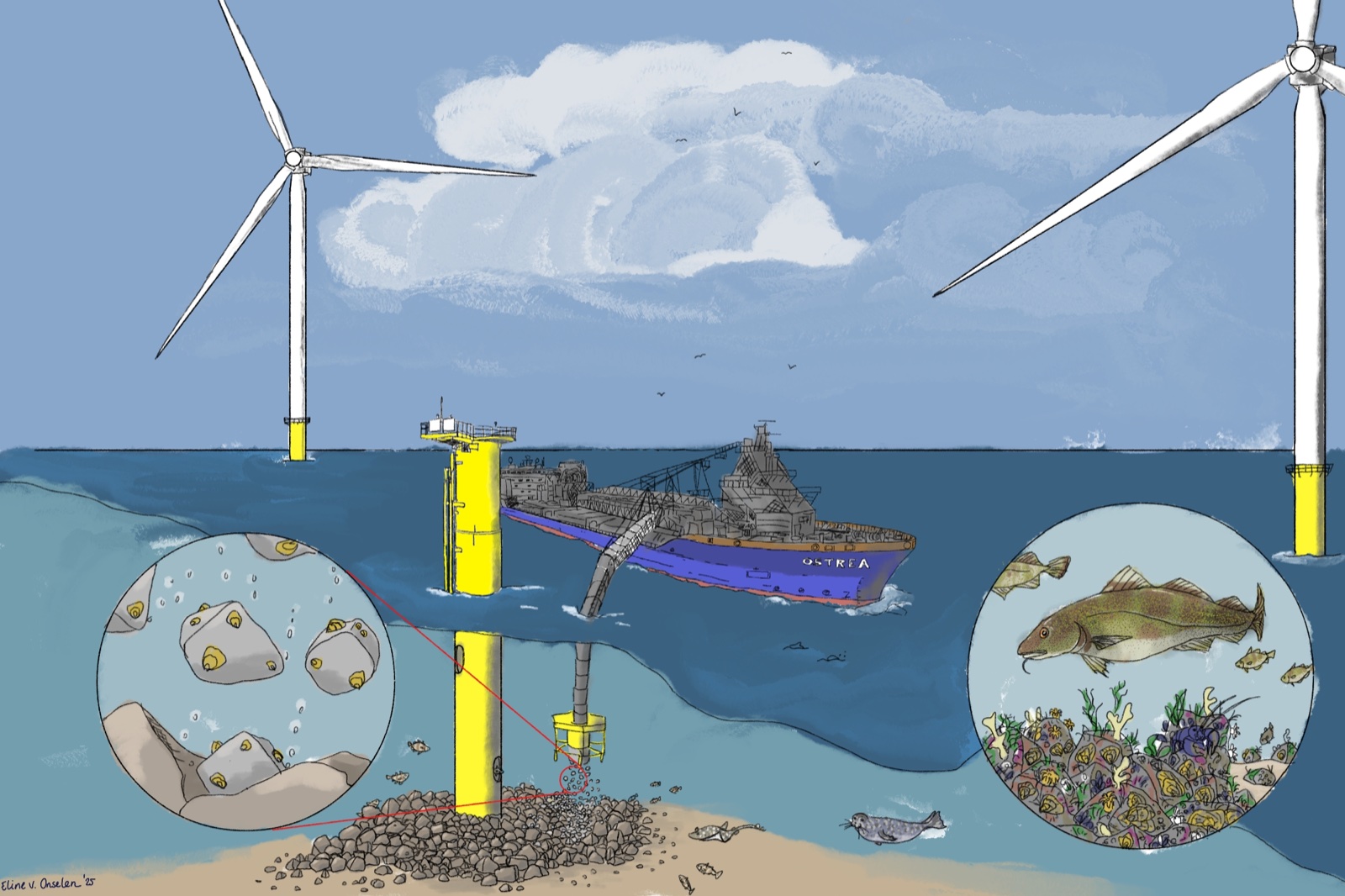
Readers of this site will recognise the thesis. Engineered structures colonised by reef life is not a side-effect to be tolerated; it is a design principle to be pursued. TOPPING applies it to infrastructure built for other purposes. Nieuw Doggerland applies it to infrastructure designed for it from the first stone.
What this means for the Dogger Bank
Our ecology programme rests on three claims: that reef restoration scales when you engineer for it, that sheltered water is the scarcest ingredient, and that the skills and supply chains would assemble if someone built the platform. The 2026 evidence keeps arriving on schedule. Orkney is releasing oysters by the million; Cornwall is planting seagrass by the hectare; and the North Sea’s largest industry is now lending its foundations to the reefs.
What none of these projects has is what we intend to supply: hundreds of square kilometres of calm, current-flushed, no-take lagoon, purpose-built for exactly this work. The restoration economy is assembling its tools. We are designing the workshop.
Sources: Ocean Conservation Trust’s Mor Nature launch, via The Scuba News and The Nature Conservancy’s TOPPING announcement.